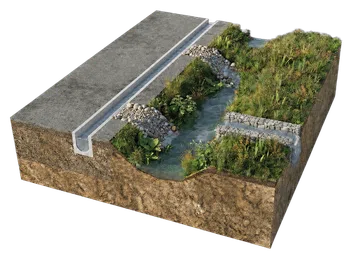
Swale and infiltration basins calculator

Proper Sizing of Swales and Infiltration Basins
How can swales and infiltration surfaces be correctly sized?
To perform the calculations, the following data is required:
- risk factor,
- design rainfall frequency,
- reduced area,
- assumed flow time through the channel [5–30 min],
- available infiltration area,
- soil infiltration coefficient.
Built-in Verification Checklist
The tool supports the design process through a checklist of key site and soil-water conditions (including groundwater level, soil permeability, distances from buildings, landslide risk, and presence of contaminants). This allows for a quick assessment of whether infiltration solutions can be applied and helps identify potential design constraints.

Results of the Swale and Infiltration Basins Sizing
Based on the provided information, the calculator determines:
- the minimum required storage volume based on the PANDa rainfall model,
- total inflow to the swale,
- total outflow from the swale.
The calculator also proposes a list of recommended solutions and allows users to review example implementations.

Note: The calculator, similarly to the guidelines on which it is based, assumes complete management of the calculated stormwater flow within the swale through infiltration into the ground supported by temporary retention. In engineering practice, when sufficient space for a facility meeting these assumptions is not available, designers should not abandon such solutions entirely.
Using this calculator, it is also possible to design a retention–infiltration basin, which differs from a swale mainly by allowing a filling depth greater than 0.3 m. In such cases, depending on the basin location and maximum water depth, additional safety considerations for the surrounding area should be taken into account.
Another practical way to use the calculator is to assess how much stormwater can be managed by a swale occupying all available space and equipped with an emergency overflow to a storm sewer system (if available nearby) or with overflow directed to another discharge location.